Kaplan Ged 2017 Strategies Practice and Review by New Readers Press Pdf
| Learning disability | |
|---|---|
| Other names | Learning difficulties,[i] [2] Developmental academic disorder,[3] [iv] Nonverbal learning disorder,[4] Developmental disorder of scholastic skills, unspecified,[4] Knowledge acquisition inability NOS,[4] Learning disability NOS,[four] Learning disorder NOS[iv] |
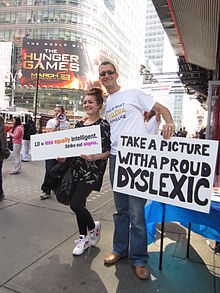 | |
| People at a Learning Disabilities Month event[5] | |
| Specialty | Psychiatry, Neurology |
Learning disability, learning disorder, or learning difficulty (British English language) is a status in the encephalon that causes difficulties comprehending or processing information and tin be caused by several dissimilar factors. Given the "difficulty learning in a typical way", this does non exclude the ability to learn in a different manner. Therefore, some people can be more accurately described as having a "learning difference", thus avoiding any misconception of existence disabled with a lack of ability to learn and possible negative stereotyping. In the Great britain, the term "learning disability" generally refers to an intellectual disability, while difficulties such every bit dyslexia and dyspraxia are usually referred to as "learning difficulties".[6]
While learning inability and learning disorder are often used interchangeably, they differ in many ways. Disorder refers to significant learning issues in an bookish surface area. These bug, however, are not enough to warrant an official diagnosis. Learning disability, on the other hand, is an official clinical diagnosis, whereby the individual meets certain criteria, as determined by a professional (such as a psychologist, psychiatrist, speech language pathologist, or pediatrician). The departure is in caste, frequency, and intensity of reported symptoms and problems, and thus the 2 should not exist dislocated. When the term "learning disorder" is used, it describes a group of disorders characterized past inadequate development of specific bookish, language, and speech skills.[vii] Types of learning disorders include reading (dyslexia), arithmetic (dyscalculia) and writing (dysgraphia).[7]
The unknown factor is the disorder that affects the brain'south ability to receive and procedure information. This disorder can make it problematic for a person to acquire equally quickly or in the same style every bit someone who is non affected past a learning inability. People with a learning inability have problem performing specific types of skills or completing tasks if left to figure things out by themselves or if taught in conventional ways.
Individuals with learning disabilities can confront unique challenges that are often pervasive throughout the lifespan. Depending on the type and severity of the disability, interventions, and current technologies may be used to help the individual larn strategies that will foster future success. Some interventions tin be quite simplistic, while others are intricate and complex. Electric current technologies may crave student training to exist effective classroom supports. Teachers, parents, and schools tin can create plans together that tailor intervention and accommodations to aid the individuals in successfully becoming independent learners. A multi-disciplinary team oft helps to design the intervention and to coordinate the execution of the intervention with teachers and parents.[8] This squad frequently includes school psychologists, special educators, speech therapists (pathologists), occupational therapists, psychologists, ESL teachers, literacy coaches, and/or reading specialists.[9]
Definition [edit]
Representatives of organizations committed to the instruction and welfare of individuals with learning disabilities are known as National Joint Committee on Learning Disabilities (NJCLD).[10] The NJCLD used the term 'learning disability' to indicate a discrepancy between a child's credible capacity to learn and their level of achievement.[11] Several difficulties existed, still, with the NJCLD standard of defining learning disability. One such difficulty was its conventionalities of central nervous system dysfunction as a basis of understanding and diagnosing learning disability. This conflicted with the fact that many individuals who experienced central nervous organization dysfunction, such as those with cerebral palsy, did non experience disabilities in learning. On the other manus, those individuals who experienced multiple handicapping conditions along with learning disability frequently received inappropriate cess, planning, and education. The NJCLD notes that information technology is possible for learning disability to occur simultaneously with other handicapping atmospheric condition, still, the two should not be straight linked together or confused.[12]
In the 1980s, NJCLD, therefore, divers the term learning disability as:
a heterogeneous grouping of disorders manifested by meaning difficulties in the acquisition and use of listening, speaking, reading, writing, reasoning or mathematical abilities. These disorders are intrinsic to the private and presumed to be due to Primal Nervous Arrangement Dysfunction. Even though a learning disability may occur concomitantly with other handicapping weather (e.chiliad. sensory harm, intellectual disability, social and emotional disturbance) or environmental influences (e.thousand. cultural differences, insufficient/inappropriate instruction, psychogenic factors) it is not the directly result of those conditions or influences.
The 2002 LD Roundtable produced the following definition:
Concept of LD: Strong converging evidence supports the validity of the concept of specific learning disabilities (SLD). This evidence is particularly impressive because it converges beyond unlike indicators and methodologies. The central concept of SLD involves disorders of learning and cognition that are intrinsic to the individual. SLD are specific in the sense that these disorders each significantly affect a relatively narrow range of academic and operation outcomes. SLD may occur in combination with other disabling conditions, simply they are non due primarily to other weather condition, such as intellectual disability, behavioral disturbance, lack of opportunities to larn, or primary sensory deficits.[xiii] [ folio needed ] [xiv]
The effect of defining learning disabilities has generated significant and ongoing controversy.[15] The term "learning disability" does non exist in DSM-Iv, but it has been added to the DSM-5. The DSM-5 does not limit learning disorders to a particular diagnosis such every bit reading, mathematics, or written expression. Instead, information technology is a single diagnosis criterion describing drawbacks in full general bookish skills and includes detailed specifiers for the areas of reading, mathematics, and written expression.[16]
United States and Canada [edit]
In the United states and Canada, the terms learning disability and learning disorder (LD) refer to a group of disorders that affect a wide range of academic and functional skills including the power to speak, heed, read, write, spell, reason, organize information, and practise math. People with learning disabilities by and large have intelligence that is average or higher.[17]
Legislation in the United states of america [edit]
The Section 504 of the Rehabilitation Act 1973, effective May 1977, guarantees certain rights to people with disabilities, especially in the cases of education and piece of work, such being in schools, colleges and university settings.[18]
The Individuals with Disabilities Education Act, formerly known as the Education for All Handicapped Children Act, is a The states federal constabulary that governs how states and public agencies provide early intervention, special education and related services to children with disabilities. Information technology addresses the educational needs of children with disabilities from birth to the age of 21.[19] Considered as a civil rights law, states are non required to participate.[ citation needed ]
Canada [edit]
In Canada, the first clan in support of children with learning disabilities was founded in 1962 by a group of concerned parents. Originally called the Clan for Children with Learning Disabilities, the Learning Disabilities Association of Canada – LDAC was created to provide awareness and services for individuals with learning disabilities, their families, at work, and the customs. Since education is largely the responsibility of each province and territory in Canada, provinces and territories have jurisdiction over the instruction of individuals with learning disabilities, which allows the development of policies and back up programs that reflect the unique multicultural, linguistic, and socioeconomic weather condition of its area.[20]
United Kingdom [edit]
In the United kingdom, terms such every bit specific learning difficulty (SpLD), developmental dyslexia, developmental coordination disorder and dyscalculia are used to cover the range of learning difficulties referred to in the U.s. as "learning disabilities". In the UK, the term "learning disability" refers to a range of developmental disabilities or weather that are almost invariably associated with more severe generalized cognitive damage.[21] The Lancet defines 'learning disability' as a "significant full general impairment in intellectual functioning caused during childhood", and states that roughly 1 in 50 British adults have one.[22]
Nihon [edit]
In Japan, acknowledgement and support for students with learning disabilities has been a adequately recent evolution, and has improved drastically in the last[ which? ] decade. The first definition for learning disability was coined in 1999, and in 2001, the Enrichment Project for the Support Organisation for Students with Learning Disabilities was established. Since then, there have been significant efforts to screen children for learning disabilities, provide follow-up back up, and provide networking between schools and specialists.[23]
Furnishings [edit]
The effects of having a learning disability or learning departure are not express to educational outcomes: individuals with learning disabilities may experience social issues every bit well. Neuropsychological differences tin bear upon the authentic perception of social cues with peers.[24] Researchers fence persons with learning disabilities not merely feel negative effects every bit a event of their learning distinctions, simply also as a upshot of carrying a stigmatizing label. Information technology has more often than not been difficult to determine the efficacy of special education services because of data and methodological limitations. Emerging research suggests adolescents with learning disabilities experience poorer academic outcomes even compared to peers who began high school with similar levels of achievement and comparable behaviors.[25] It seems their poorer outcomes may exist at least partially due to the lower expectations of their teachers; national information show teachers hold expectations for students labeled with learning disabilities that are inconsistent with their academic potential (as evidenced by test scores and learning behaviors).[26] It has been said that there is a strong connection between children with a learning inability and their educational performance.[27]
Many studies have been washed to assess the correlation between learning disability and self-esteem. These studies have shown that an individual's cocky-esteem is indeed affected by their own sensation of their learning inability. Students with a positive perception of their academic abilities mostly tend to have college self-esteem than those who do not, regardless of their actual academic achievement. However, studies accept also shown that several other factors can influence self-esteem. Skills in non-bookish areas, such as athletics and arts, better self-esteem. Also, a positive perception of i'due south physical appearance has too been shown to have positive effects of self-esteem. Another important finding is that students with learning disabilities are able to distinguish betwixt academic skill and intellectual chapters. This demonstrates that students who acknowledge their academic limitations only are also aware of their potential to succeed in other intellectual tasks meet themselves as intellectually competent individuals, which increases their cocky-esteem.[28]
Research involving individuals with learning disabilities who showroom challenging behaviors who are later on treated with antipsychotic medications provides little show that whatsoever benefits outweigh the adventure.[29]
Causes [edit]
The causes for learning disabilities are non well understood, and sometimes in that location is no apparent cause for a learning inability. However, some causes of neurological impairments include:
- Heredity and genetics
- Learning disabilities are ofttimes linked through genetics and run in the family unit. Children who have learning disabilities ofttimes have parents who take the aforementioned struggles. Children of parents who had less than 12 years of school are more likely to accept a reading inability. Some children accept spontaneous mutations (i.east. not present in either parent) which tin cause developmental disorders including learning disabilities.[xxx] One written report[31] estimated that about one in 300 children had such spontaneous mutations, for instance a mistake in the CDK13 gene which is associated with learning and advice difficulties in the children affected.[32]
- Problems during pregnancy and nascence
- A learning disability tin can outcome from anomalies in the developing brain, affliction or injury. Adventure factors are fetal exposure to alcohol or drugs and low nascence weight (three pounds or less). These children are more than probable to develop a inability in math or reading. Children who are born prematurely, belatedly, have a longer labor than usual, or have trouble receiving oxygen are more likely to develop a learning disability.[30]
- Accidents after birth
- Learning disabilities tin besides be caused by head injuries, malnutrition, or by toxic exposure (such every bit heavy metals or pesticides).[33] [34]
Diagnosis [edit]
IQ-achievement discrepancy [edit]
Learning disabilities tin be identified by psychiatrists, speech language pathologists, school psychologists, clinical psychologists, counseling psychologists, neuropsychologists, speech communication language pathologists, and other learning disability specialists through a combination of intelligence testing, bookish accomplishment testing, classroom performance, and social interaction and bent. Other areas of assessment may include perception, cognition, memory, attending, and linguistic communication abilities. The resulting information is used to determine whether a child's academic operation is commensurate with their cognitive power. If a child'south cognitive power is much higher than their bookish performance, the student is often diagnosed with a learning disability. The DSM-4 and many schoolhouse systems and government programs diagnose learning disabilities in this manner (DSM-Iv uses the term "disorder" rather than "disability").
Although the discrepancy model has dominated the school system for many years, there has been substantial criticism of this approach among researchers.[35] [36] Recent research has provided fiddling show that a discrepancy betwixt formally measured IQ and achievement is a clear indicator of LD.[37] Furthermore, diagnosing on the basis of a discrepancy does not predict the effectiveness of treatment. Low bookish achievers who exercise not have a discrepancy with IQ (i.eastward. their IQ scores are also depression) announced to benefit from treatment only as much as low bookish achievers who do have a discrepancy with IQ (i.east. their IQ scores are higher than their academic performance would suggest).
Since 1998 there accept been attempts to create a reference index more useful than IQ to generate predicted scores on achievement tests. For example, for a student whose vocabulary and general noesis scores matches their reading comprehension score a instructor could assume that reading comprehension can be supported through piece of work in vocabulary and general knowledge. If the reading comprehension score is lower in the appropriate statistical sense it would be necessary to commencement rule out things like vision problems[38]
Response to intervention [edit]
Much electric current research has focused on a treatment-oriented diagnostic procedure known as response to intervention (RTI). Researcher recommendations for implementing such a model include early screening for all students, placing those students who are having difficulty into research-based early intervention programs, rather than waiting until they run into diagnostic criteria. Their performance tin can be closely monitored to determine whether increasingly intense intervention results in adequate progress.[37] Those who answer will not require further intervention. Those who do not respond adequately to regular classroom instruction (oft called "Tier 1 educational activity") and a more intensive intervention (often called "Tier 2" intervention) are considered "not-responders." These students can then be referred for further assistance through special education, in which case they are oft identified with a learning disability. Some models of RTI include a third tier of intervention before a child is identified as having a learning disability.
A primary benefit of such a model is that information technology would non be necessary to await for a kid to be sufficiently far behind to qualify for assistance.[39] This may enable more than children to receive assistance before experiencing significant failure, which may, in turn, consequence in fewer children who demand intensive and expensive special education services. In the United States, the 2004 reauthorization of the Individuals with Disabilities Education Human activity permitted states and school districts to use RTI as a method of identifying students with learning disabilities. RTI is now the primary means of identification of learning disabilities in Florida.
The process does not take into business relationship children's individual neuropsychological factors such as phonological awareness and retentiveness, that tin can inform design instruction. By non taking into account specific cognitive processes, RTI fails to inform educators about a students' relative strengths and weaknesses[40] Second, RTI past design takes considerably longer than established techniques, often many months to find an appropriate tier of intervention. Tertiary, information technology requires a strong intervention programme before students tin be identified with a learning disability. Lastly, RTI is considered a regular education initiative and consists of members of general didactics teachers, in conjunction with other qualified professionals.[8] Occupational therapists (OT's) in detail tin back up students in the educational setting by helping children in academic and non-academic areas of school including the classroom, recess and meal fourth dimension. They can provide strategies, therapeutic interventions, suggestions for adaptive equipment, and ecology modifications. OT's can work closely with the kid's instructor and parents to facilitate educational goals specific to each kid under an RTI and/or IEP.[8]
Latino English language language learners [edit]
Demographers in the United States report that there has been a meaning increment in immigrant children in the United States over the by two decades.[41] This data is vital because it has been and will proceed to bear on both students and how educators approach education methods. Various teaching strategies are more than successful for students that are linguistic or culturally diverse versus traditional methods of teaching used for students whose get-go language is English language. It is so as well truthful that the proper way to diagnose a learning disability in English language learners (ELL) differs. In the United states of america, there has been a growing need to develop the noesis and skills necessary to provide effective school psychological services, specifically for those professionals who piece of work with immigrant populations.[42]
Currently, at that place are no standardized guidelines for the process of diagnosing English language learners (ELL) with specific learning disabilities (SLD). This is a problem since many students will fall through the cracks as educators are unable to clearly assess if a student'south delay is due to a linguistic communication barrier or true learning disability. With an unclear diagnosis, many students will suffer because they volition non be provided with the tools they need to succeed in the public education school system. For case, in many occasions teachers take suggested retention or take taken no activeness at all when they lack experience working with English linguistic communication learners. Students were commonly pushed toward testing, based on an assumption that their poor bookish performance or behavioral difficulties indicated a demand for special educational activity.[43] Linguistically responsive psychologist understand that second linguistic communication acquisition is a process and they empathise how to support ELLs' growth in language and academically.[44] When ELLs are referred for a psychoeducational assessment, it is difficult to isolate and disentangle what are the effects of the language acquisition process, from poor quality educational services, from what may be academic difficulties that result from processing disorders, attention problems, and learning disabilities.[43] Additionally non having trained staff and faculty becomes more of an issue when staff is unaware of numerous types of psychological factors that immigrant children in the U.Due south dealing could be potentially dealing with. These factors that include acculturation, fear and/or worry of deportation, separation from social supports such every bit parents, linguistic communication barriers, disruptions in learning experiences, stigmatization, economic challenge, and risk factors associated with poverty.[45] [46] In the U.s.a., in that location are no fix policies mandating that all districts employ bilingual school psychologist, nor are schools equipped with specific tools and resources to assist immigrant children and families. Many schoolhouse districts do not have the proper personnel that is able to communicate with this population.[47] [ page needed ]
Spanish-speaking ELL [edit]
A well trained bilingual school psychologist will be able to administrate and translate cess all psychological testing tool. Also, an accent is placed on informal cess measures such as linguistic communication samples, observations, interviews, and rating scales as well as curriculum-based measurement to complement data gathered from formal assessments.[46] [48] A compilation of these tests is used to assess whether an ELL student has a learning disability or merely is academically delayed because of language barriers or environmental factors. Information technology is very unfortunate that many schools practise not have school psychologist with the proper grooming nor access to appropriate tools. Likewise, many school districts frown upon taking the advisable steps to diagnosing ELL students.
Assessment [edit]
Many normed assessments can exist used in evaluating skills in the chief bookish domains: reading, including word recognition, fluency, and comprehension; mathematics, including ciphering and trouble solving; and written expression, including handwriting, spelling and limerick.
The most commonly used comprehensive achievement tests include the Woodcock-Johnson IV (WJ Four), Wechsler Individual Accomplishment Test II (WIAT 2), the Wide Range Accomplishment Test 3 (WRAT III), and the Stanford Achievement Test–10th edition. These tests include measures of many academic domains that are reliable in identifying areas of difficulty.[37]
In the reading domain, at that place are also specialized tests that tin can be used to obtain details about specific reading deficits. Assessments that measure multiple domains of reading include Gray's Diagnostic Reading Tests–2nd edition (GDRT Ii) and the Stanford Diagnostic Reading Assessment. Assessments that measure reading subskills include the Gray Oral Reading Test IV – Quaternary Edition (GORT IV), Grayness Silent Reading Test, Comprehensive Examination of Phonological Processing (CTOPP), Tests of Oral Reading and Comprehension Skills (TORCS), Test of Reading Comprehension iii (TORC-iii), Test of Word Reading Efficiency (TOWRE), and the Test of Reading Fluency. A more comprehensive listing of reading assessments may be obtained from the Southwest Educational Development Laboratory.[49]
The purpose of assessment is to determine what is needed for intervention, which also requires consideration of contextual variables and whether there are comorbid disorders that must also be identified and treated, such every bit behavioral issues or language delays.[37] These contextual variables are often assessed using parent and teacher questionnaire forms that rate the students' behaviors and compares them to standardized norms.
However, caution should be fabricated when suspecting the person with a learning disability may likewise accept dementia, especially equally people with Down's syndrome may take the neuroanatomical contour simply not the associated clinical signs and symptoms.[l] Examination tin be carried out of executive operation as well as social and cognitive abilities but may need adaptation of standardized tests to take business relationship of special needs.[51] [52] [53] [54]
Types [edit]
Learning disabilities can be categorized by either the type of information processing afflicted past the disability or by the specific difficulties caused past a processing arrears.
By stage of data processing [edit]
Learning disabilities fall into broad categories based on the iv stages of information processing used in learning: input, integration, storage, and output.[55] Many learning disabilities are a compilation of a few types of abnormalities occurring at the same time, too every bit with social difficulties and emotional or behavioral disorders.[56]
- Input
- This is the information perceived through the senses, such as visual and auditory perception. Difficulties with visual perception tin crusade problems with recognizing the shape, position, or size of items seen. In that location tin can be issues with sequencing, which can chronicle to deficits with processing time intervals or temporal perception. Difficulties with auditory perception tin brand information technology difficult to screen out competing sounds in order to focus on one of them, such as the sound of the teacher's voice in a classroom setting. Some children announced to be unable to process tactile input. For case, they may seem insensitive to pain or dislike existence touched.
- Integration
- This is the stage during which perceived input is interpreted, categorized, placed in a sequence, or related to previous learning. Students with problems in these areas may be unable to tell a story in the correct sequence, unable to memorize sequences of information such as the days of the week, able to understand a new concept only be unable to generalize it to other areas of learning, or able to learn facts but be unable to put the facts together to see the "big picture." A poor vocabulary may contribute to bug with comprehension.
- Storage
- Issues with retentiveness tin occur with brusk-term or working retention, or with long-term retention. Most retentivity difficulties occur with one's short-term retention, which can brand it difficult to learn new material without more repetitions than usual. Difficulties with visual retention tin impede learning to spell.
- Output
- Data comes out of the brain either through words, that is, language output, or through muscle activity, such every bit gesturing, writing or drawing. Difficulties with linguistic communication output can create problems with spoken language. Such difficulties include answering a question on demand, in which ane must recall data from storage, organize our thoughts, and put the thoughts into words before we speak. It tin as well crusade trouble with written language for the same reasons. Difficulties with motor abilities tin can cause issues with gross and fine motor skills. People with gross motor difficulties may be impuissant, that is, they may be decumbent to stumbling, falling, or bumping into things. They may also have trouble running, climbing, or learning to ride a bicycle. People with fine motor difficulties may have trouble with handwriting, buttoning shirts, or tying shoelaces.
Past office impaired [edit]
Deficits in any surface area of information processing tin can manifest in a variety of specific learning disabilities. It is possible for an private to have more than than one of these difficulties. This is referred to as comorbidity or co-occurrence of learning disabilities.[57] In the Uk, the term dual diagnosis is oftentimes used to refer to co-occurrence of learning difficulties.
Reading disorder (ICD-x and DSM-IV codes: F81.0/315.00) [edit]
Reading disorder is the almost mutual learning disability.[58] Of all students with specific learning disabilities, seventy–80% have deficits in reading. The term "Developmental Dyslexia" is oftentimes used equally a synonym for reading inability; still, many researchers assert that in that location are different types of reading disabilities, of which dyslexia is one. A reading disability tin can affect any part of the reading process, including difficulty with accurate or fluent discussion recognition, or both, discussion decoding, reading rate, prosody (oral reading with expression), and reading comprehension. Before the term "dyslexia" came to prominence, this learning disability used to be known as "word blindness."
Common indicators of reading disability include difficulty with phonemic sensation—the ability to break up words into their component sounds, and difficulty with matching letter combinations to specific sounds (sound-symbol correspondence).
Disorder of written expression (ICD-10 and DSM-4-TR codes 315.2) [edit]
The DSM-Iv-TR criteria for a disorder of written expression is writing skills (as measured past a standardized test or functional assessment) that fall substantially below those expected based on the individual'south chronological age, measured intelligence, and historic period-appropriate education, (Criterion A). This difficulty must likewise cause pregnant impairment to academic achievement and tasks that require composition of written text (Criterion B), and if a sensory deficit is present, the difficulties with writing skills must exceed those typically associated with the sensory deficit, (Criterion C).[59]
Individuals with a diagnosis of a disorder of written expression typically have a combination of difficulties in their abilities with written expression as evidenced by grammatical and punctuation errors within sentences, poor paragraph system, multiple spelling errors, and excessively poor penmanship. A disorder in spelling or handwriting without other difficulties of written expression exercise non by and large authorize for this diagnosis. If poor handwriting is due to an impairment in the individuals' motor coordination, a diagnosis of developmental coordination disorder should exist considered.
Past a number of organizations, the term "dysgraphia" has been used as an overarching term for all disorders of written expression.
Math disability (ICD-10 and DSM-4 codes F81.2-iii/315.1) [edit]
Sometimes called dyscalculia, a math disability involves difficulties such equally learning math concepts (such as quantity, place value, and time), difficulty memorizing math facts, difficulty organizing numbers, and agreement how problems are organized on the page. Dyscalculics are frequently referred to as having poor "number sense".[sixty]
Non ICD-10/DSM [edit]
- Nonverbal learning disability: Nonverbal learning disabilities often manifest in motor awkwardness, poor visual-spatial skills, problematic social relationships, difficulty with mathematics, and poor organizational skills. These individuals often accept specific strengths in the verbal domains[ additional citation(s) needed ], including early speech, large vocabulary, early on reading and spelling skills, fantabulous rote retentivity and auditory retention, and eloquent self-expression.[61]
- Disorders of speaking and listening: Difficulties that often co-occur with learning disabilities include difficulty with retention, social skills and executive functions (such equally organizational skills and fourth dimension management).[ commendation needed ]
Management [edit]

Interventions include:
- Mastery model:
- Learners work at their ain level of mastery.
- Practise
- Gain primal skills before moving onto the next level
- Notation: this approach is virtually probable to be used with adult learners or outside the mainstream school system.
- Directly instruction:[62]
- Emphasizes advisedly planned lessons for small learning increments
- Scripted lesson plans
- Rapid-paced interaction between teacher and students
- Correcting mistakes immediately
- Achievement-based grouping
- Frequent progress assessments
- Classroom adjustments:
- Special seating assignments
- Alternative or modified assignments
- Modified testing procedures
- Serenity environment
- Special equipment:
- Word processors with spell checkers and dictionaries
- Text-to-spoken communication and speech-to-text programs
- Talking calculators
- Books on tape
- Computer-based activities
- Classroom assistants:
- Notation-takers
- Readers
- Proofreaders
- Scribes
- Special instruction:
- Prescribed hours in a resources room
- Placement in a resources room[63]
- Enrollment in a special school or a carve up classroom in a regular school[64] for learning disabled students
- Individual pedagogy plan (IEP)
- Educational therapy
Sternberg[65] has argued that early remediation tin can greatly reduce the number of children meeting diagnostic criteria for learning disabilities. He has besides suggested that the focus on learning disabilities and the provision of accommodations in school fails to admit that people have a range of strengths and weaknesses, and places undue emphasis on academic success by insisting that people should receive additional support in this arena but not in music or sports. Other research has pinpointed the apply of resources rooms as an of import—yet frequently politicized component of educating students with learning disabilities.[66]
Society and culture [edit]
School laws [edit]
Schools in the United states of america have a legal obligation to new arrivals to the country, including undocumented students. The landmark Supreme Court ruling Plyler v. Doe (1982) grants all children, no matter their legal status, the right to a free education.[67] [68] This ruling suggests that every bit a country we acknowledge that we accept a population of students with specific needs that differ from those of native speakers. Additionally specifically in regards to ELL'southward the supreme court ruling Lau v. Nichols (1974) stated that equal treatment in school did non mean equal educational opportunity.[69] Thus if a school teaches a lesson in a language that students practice not understand and so they are finer worthless. This ruling is too supported by English language language development services provided in schools, merely these rulings practise non require the individuals that teach and provide services to take whatever specific training nor is licensing dissimilar from a typical teacher or services provider.
Critique of the medical model [edit]
Learning disability theory is founded in the medical model of disability, in that inability is perceived every bit an private deficit that is biological in origin.[70] [71] Researchers working within a social model of disability assert that at that place are social or structural causes of disability or the assignation of the label of disability, and fifty-fifty that inability is entirely socially constructed.[71] [72] [73] [74] [75] Since the turn of the 19th century, education in the United States has been geared toward producing citizens who tin can effectively contribute to a capitalistic social club, with a cultural premium on efficiency and science.[76] [77] More agrestal cultures, for case, do not even utilise learning ability as a measure of adult adequacy,[78] [79] whereas the diagnosis of learning disabilities is prevalent in Western capitalistic societies because of the loftier value placed on speed, literacy, and numeracy in both the labor forcefulness and school system.[lxxx] [81] [82]
Culture [edit]
There are three patterns that are well known in regards to mainstream students and minority labels in the U.s.:
- "A higher percentage of minority children than of white children are assigned to special education";
- "inside special instruction, white children are assigned to less restrictive programs than are their minority counterparts";
- "the data — driven past inconsistent methods of diagnosis, treatment, and funding — make the overall system difficult to draw or alter".[83]
In the nowadays day, it has been reported that white districts accept more children from minority backgrounds enrolled in special education than they do majority students. "Information technology was also suggested that districts with a higher percentage of minority kinesthesia had fewer minority students placed in special education suggesting that 'minority students are treated differently in predominantly white districts than in predominantly minority districts'".[84]
Educators have only recently started to look into the furnishings of culture on learning disabilities.[85] If a instructor ignores a student's culturally diverse background, the student will endure in the class. "The cultural repertoires of students from cultural learning disorder backgrounds accept an impact on their learning, schoolhouse progress, and behavior in the classroom".[86] These students may then act out and not excel in the classroom and will, therefore, exist misdiagnosed: "Overall, the information indicates that at that place is a persistent concern regarding the misdiagnosis and inappropriate placement of students from various backgrounds in special education classes since the 1975".[84]
[edit]
Learning disabilities have a disproportionate identification of racial and ethnic minorities and students who have low socioeconomic condition (SES). While some attribute the disproportionate identification of racial/ethnic minorities to racist practices or cultural misunderstanding,[87] [88] others take argued that racial/ethnic minorities are overidentified considering of their lower status.[89] [90] Similarities were noted between the behaviors of "encephalon-injured" and lower class students as early on as the 1960s.[72] The distinction between race/ethnicity and SES is important to the extent that these considerations contribute to the provision of services to children in need. While many studies take considered only one characteristic of the educatee at a time,[91] or used commune- or school-level data to examine this consequence, more than recent studies take used large national student-level datasets and sophisticated methodology to find that the asymmetric identification of African American students with learning disabilities can be attributed to their average lower SES, while the disproportionate identification of Latino youth seems to exist owing to difficulties in distinguishing between linguistic proficiency and learning ability.[92] [93] Although the contributing factors are complicated and interrelated, it is possible to discern which factors really drive disproportionate identification by because a multitude of educatee characteristics simultaneously. For instance, if loftier SES minorities have rates of identification that are similar to the rates amid high SES Whites, and low SES minorities have rates of identification that are like to the rates among depression SES Whites, nosotros can know that the seemingly college rates of identification among minorities result from their greater likelihood to have low SES. Summarily, considering the adventure of identification for White students who have depression SES is similar to that of Black students who take depression SES, future research and policy reform should focus on identifying the shared qualities or experiences of low SES youth that lead to their disproportionate identification, rather than focusing exclusively on racial/indigenous minorities.[92] [93] It remains to be determined why lower SES youth are at higher risk of incidence, or perchance just of identification, with learning disabilities.
Learning disabilities in adulthood [edit]
A mutual misconception virtually those with learning disabilities is that they outgrow it as they enter machismo. This is often not the case and most adults with learning disabilities still require resources and care to help manage their disability. One resource available is the Adult Bones Education (ABE) programs, at the state level. ABE programs are allotted certain amounts of funds per country in order to provide resource for adults with learning disabilities.[94] This includes resource to assistance them acquire basic life skills in order to provide for themselves. ABE programs also provide help for adults who lack a high school diploma or an equivalent. These programs teach skills to help adults get into the workforce or into a further level of didactics. At that place is a certain pathway that these adults and instructors should follow in order to ensure these adults take the abilities needed to succeed in life.[95] Some ABE programs offer GED preparation programs to support adults through the process to get a GED. [96] It is important to note that ABE programs do not always have the expected outcome on things like employment. Participants in ABE programs are given tools to aid them succeed and get a job just, employment is dependent on more than than just a guarantee of a job post-ABE. Employment varies based on the level of growth a participant experiences in an ABE program, the personality and beliefs of the participant, and the chore market they are inbound into post-obit completion of an ABE program. [96]
Another plan to assist adults with disabilities are federal programs chosen "dwelling house and community based services" (HCBS). Medicaid funds these programs for many people through a fee waiver system, however, there are nevertheless lots of people on a stand-by listing. [97] These programs are primarily used for adults with Autism Spectrum Disorders. [97] HCBS programs offer service more dedicated to caring for the developed, not so much providing resources for them to transition into the workforce. Some services provided are: therapy, social skills training, back up groups, and counseling. [97]
Contrast with other conditions [edit]
People with an IQ lower than 70 are usually characterized every bit having an intellectual disability and are not included under nearly definitions of learning disabilities because their difficulty in learning are considered to be related straight to their overall low intelligence.
Attending-deficit hyperactivity disorder (ADHD) is often studied in connection with learning disabilities, merely it is non actually included in the standard definitions of learning disabilities. Individuals with ADHD may struggle with learning, but can often learn adequately once successfully treated for the ADHD. A person tin can have ADHD but not learning disabilities or have learning disabilities without having ADHD. The conditions tin co-occur.[98]
People diagnosed with ADHD sometimes have dumb learning. Some of the struggles people with ADHD take might include lack of motivation, high levels of anxiety, and the inability to process data.[99] At that place are studies that suggest people with ADHD generally have a positive attitude toward academics and, with medication and developed study skills, can perform just as well equally individuals without learning disabilities. Too, using alternate sources of gathering information, such every bit websites, written report groups and learning centers, can assist a person with ADHD exist academically successful.[99]
Before the discovery of ADHD, it was technically included in the definition of LDs since information technology has a very pronounced effect on the "executive functions" required for learning. Thus historically, ADHD was not clearly distinguished from other disabilities related to learning.[ commendation needed ] Therefore, when a patient presents with difficulties in learning, the presence of ADHD has to be ruled out. Scientific research continues to explore the traits, struggles, effective learning styles and comorbid LDs of those with ADHD.
References [edit]
- ^ "Developmental academic disorder (Concept Id: C1330966) - MedGen". NCBI. 2019-12-20. Retrieved 2019-12-20 .
- ^ "What are learning difficulties?". Bear on-type Read and Spell (TTRS). 2019-05-31. Retrieved 2019-12-xx .
- ^ "Code Organization Concept". phinvads.cdc.gov. 2018-12-05. Retrieved 2019-12-20 .
- ^ a b c d due east f "2020 ICD-10-CM Diagnosis Code F81.9: Developmental disorder of scholastic skills, unspecified". The Web'south Complimentary 2019/2020 ICD-10-CM/PCS Medical Coding Reference. 2019-10-01. Retrieved 2019-12-20 .
- ^ Kate Adams (September thirty, 2012). "October Is Learning Disabilities Awareness Calendar month in Canada!". baytoday.ca. LDAO – North Bay and Area News Release. Retrieved 28 April 2015.
- ^ Gates, Bob; Mafuba, Kay (1 March 2016). "Use of the term 'learning disabilities' in the United kingdom of great britain and northern ireland: issues for international researchers and practitioners". Learning Disabilities: A Contemporary Journal. 14 (ane): 9–23. ISSN 1937-6928.
- ^ a b Childhood Voyages in Evolution, Third Edition, Thomson Wadsworth. (2008), p. 387. Retrieved 2012-12-19.
- ^ a b c Reeder, Deborah L.; Arnold, Sandra H.; Jeffries, Lynn Grand.; McEwen, Irene R. (2011-01-xix). "The Role of Occupational Therapists and Physical Therapists in Uncomplicated Schoolhouse System Early Intervening Services and Response to Intervention: A Case Report". Concrete & Occupational Therapy in Pediatrics. 31 (ane): 44–57. doi:10.3109/01942638.2010.497180. ISSN 0194-2638. PMID 20735199. S2CID 24507004.
- ^ Dougherty Stahl, Katherine A. (May 2016). "Response to Intervention: Is the Sky Falling?". The Reading Instructor. 69 (6): 659–663. doi:10.1002/trtr.1457.
- ^ "National Joint Committee on Learning Disabilities". LD Online. WETA. 2010.
- ^ 1981; 1985.[ full citation needed ]
- ^ Disabilities, National Joint Committee on Learning (May 1987). "LD Definition". Learning Inability Quarterly. 10 (2): 136–138. doi:10.2307/1510220. JSTOR 1510220. S2CID 29770180.
- ^ Bradley, Renée; Danielson, Louis C.; Hallahan, Daniel P. (2002). Identification of learning disabilities: research to practice. Routledge. ISBN978-0-8058-4448-1 . Retrieved two May 2010.
- ^ Reschly, Daniel J.; Hosp, John 50.; Schmied, Catherine M. (20 August 2003). And Miles to Go…: State SLD Requirements and Authoritative Recommendations (Report). National Research Center on Learning Disabilities (NRCLD). Recommendations for Change in SLD Definition and Classification Criteria. Archived from the original on 25 September 2010. Retrieved 2010-05-01 .
- ^ Reiff, Henry B.; Gerber, Paul J.; Ginsberg, Rick (Jump 1993). "Definitions of Learning Disabilities from Adults with Learning Disabilities: The Insiders' Perspectives". Learning Disability Quarterly. 16 (2): 114–125. doi:10.2307/1511133. JSTOR 1511133. S2CID 143368446.
- ^ "Specific Learning Disorder" (PDF). American Psychiatric Clan DSM-five Development. American Psychiatric Clan. fifteen May 2013.
- ^ "Types of Learning Disabilities". Learning Disabilities Association of America. 2013-09-xx. Retrieved 4 July 2018.
- ^ Wegner, Judith Welch (1984). "The Antodiscrimination Model Reconsidered: Ensuring Equal Opportunity Without Respect to Handicap Under Section 504 of the Rehabilitation Human activity of 1973". Cornell Law Review. 69 (3): 401–516. PMID 10317437.
- ^ 20 The statesC. § 1400 et seq.
- ^ Stegemann, Thousand. C. (2016). Learning disabilities in Canada. Learning Disabilities: A Contemporary Periodical, (one), 53. Retrieved November i, 2016
- ^ The netherlands, Ken (Feb 2011). "Learning Disabilities Factsheet". bild.org.uk. British Institute of Learning Disabilities. Retrieved 13 September 2017.
- ^ "Demography still dictates destiny for children with disabilities". Lancet. 386 (9993): 503. 2015. doi:10.1016/S0140-6736(15)61459-3. PMID 26293424.
- ^ Kataoka, Mika; van Kraayenoord, Christina E.; Elkins, John (August 2004). "Principals' and Teachers' Perceptions of Learning Disabilities: A Written report from NARA Prefecture, Nihon". Learning Disability Quarterly. 27 (3): 161–175. doi:10.2307/1593666. JSTOR 1593666. S2CID 152478.
- ^ Rourke, B. P. (1989). Nonverbal learning disabilities: The syndrome and the model. New York: Guilford Press.
- ^ Shifrer, Dara; Callahan, Rebecca; Muller, Chandra (2013). "Equity or Marginalization? The High School Class-Taking of Students Labeled With a Learning Inability". American Educational Research Journal. 50 (4): 656–82. doi:ten.3102/0002831213479439. PMC4074008. PMID 24982511.
- ^ Shifrer, Dara (2013). "Stigma of a Label: Educational Expectations for High School Students Labeled with a Learning Disability". Journal of Health and Social Behavior. 54 (four): 462–480. doi:10.1177/0022146513503346. PMID 24311756.
- ^ Genizi, Jacob; Gordon, Shiri; Kerem, Nogah C.; Srugo, Isaac; Shahar, Eli; Ravid, Sarit (27 June 2013). "Master headaches, attention deficit disorder and learning disabilities in children and adolescents". The Journal of Headache and Pain. 14 (1): 54. doi:10.1186/1129-2377-fourteen-54. PMC3698063. PMID 23806023.
- ^ Cisden, Merith; Elliot, Katherine; Noble, Sharon; Kelemen, Eve (1999). "Self-Understanding and Self-Esteem in Children with Learning Disabilities". Learning Disability Quarterly. 22 (iv): 279–290. doi:10.2307/1511262. JSTOR 1511262. S2CID 146844450.
- ^ Brylewski, J.; Duggan, Fifty. (2004). "Antipsychotic medication for challenging behaviour in people with learning inability". The Cochrane Database of Systematic Reviews (three): CD000377. doi:10.1002/14651858.CD000377.pub2. ISSN 1469-493X. PMID 15266428.
- ^ a b Johnson, Beena. "Learning Disabilities in Children: Epidemiology, Risk Factors and Importance of Early Intervention." BMH Med J, vol. 4, no. ane, ser. 31-37, 2017. 31-37, doi:22348-393X.
- ^ McRae, Jeremy F.; Clayton, Stephen; Fitzgerald, Tomas Westward.; Kaplanis, Joanna; Prigmore, Elena; Rajan, Diana; Sifrim, Alejandro; Aitken, Stuart; Akawi, Nadia (2017). "Prevalence and architecture of de novo mutations in developmental disorders" (PDF). Nature. 542 (7642): 433–438. Bibcode:2017Natur.542..433M. doi:10.1038/nature21062. PMC6016744. PMID 28135719.
- ^ Walsh, Fergus (2017-01-25). "Child gene written report identifies new developmental disorders". BBC News . Retrieved 2017-01-27 .
- ^ "Helping Children with Learning Difficulty". Credible Lifestyle. 9 July 2014.
- ^ Winogron, H. Due west., Knights, R. Grand., & Bawden, H. Northward. (1984). "Neuropsychological deficits following head injury in children". Journal of Clinical and Experimental Neuropsychology. vi (3): 269–286. doi:x.1080/01688638408401218. PMID 6470165.
{{cite periodical}}: CS1 maint: multiple names: authors list (link) - ^ Aaron, P.G. (1995). "Differential Diagnosis of Reading Disabilities". School Psychology Review. 24 (three): 345–60. doi:10.1080/02796015.1995.12085773. ISSN 0279-6015.
- ^ Patti L. Harrison; Flanagan, Dawn P. (2005). Gimmicky intellectual assessment: theories, tests, and issues. New York: Guilford Press. ISBN1-59385-125-ane.
- ^ a b c d Marcia A. Barnes; Fletcher, Jack; Fuchs, Lynn (2007). Learning Disabilities: From Identification to Intervention. New York: The Guilford Press. ISBN978-1-59385-370-9.
- ^ Tulsky; et al. (2001). "Development of a full general ability alphabetize for the Wechsler Adult Intelligence Scale--Third Edition". Psychol Appraise. 13 (3): 566–71. doi:ten.1037//1040-3590.13.4.566. PMID 11793899.
- ^ Finn, C.E., Rotherham A.J. & Hokanson C.R. (2001). "Rethinking Special Didactics For A New Century". Progressive Policy Constitute. Archived from the original on 2011-01-28. Retrieved 2007-06-03 .
- ^ Fletcher-Janzen, Reynolds. (2008). Neuropsychological Perspectives on Learning Disabilities in the Era of RTI: Recommendations for Diagnosis and Intervention
- ^ Child Trends, 2014.[ total citation needed ]
- ^ Ruiz, Melissa; Kabler, Brenda; Sugarman, Melissa (January 2011). "Understanding the plight of immigrant and refugee students". Communiqué. National Association of Schoolhouse Psychologists. 39 (5).
- ^ a b Klingner, Janette M.; Harry, Beth (2006). "The special instruction referral and decision-making process for English language learners: Child report squad meetings and placement conferences". Teachers College Record. 108 (11): 2247–2281. doi:10.1111/j.1467-9620.2006.00781.10.
- ^ Rodriguez et al., 2014.[ full commendation needed ]
- ^ Jones, 2009; Martines, 2008; Rhodes.[ full citation needed ]
- ^ a b Ochoa, & Ortiz, 2005.[ full citation needed ]
- ^ Frisby, Craig L. (2013). Meeting the psychoeducational needs of minority students: Evidence-based guidelines for school psychologists and other school personnel. Hoboken, NJ: Wiley and Sons. doi:x.1002/9781118092620. ISBN978-1-118-09262-0. OCLC 822560271.
- ^ Geva, E., & Wiener, J. (2015). Psychological assessment of culturally and linguistically diverse children and adolescents: A practitioner'southward guide. New York, NY: Springer.
- ^ Southwest Educational Development Laboratory (SEDL), 2007.Southwest Educational Development Laboratory Accessed September 15, 2007.
- ^ Thompson, Due south.B.North. "Dementia and memory: a guide for students and wellness professionals." Aldershot: Ashgate 2006.
- ^ Thompson, Southward.B.Due north. (2000). "The Key Executive Organisation in people with Down's syndrome and dementia". Clinical Gerontologist. 21 (3): iii–32. doi:ten.1300/j018v21n03_02.
- ^ Thompson, Due south.B.N. (2000). "Investigation into Down's syndrome and dementia". Journal of the Clan of Practitioners in Learning Disability. 17 (3): x–14.
- ^ Thompson, Due south.B.Northward. (1999). "Examining dementia in Downward'south syndrome (DS): decline in social abilities in DS compared with other learning disabilities". Clinical Gerontologist. twenty (iii): 23–44. doi:x.1300/j018v20n03_04.
- ^ Thompson, S.B.N. (1999). "Assessing dementia in people with learning disabilities for cerebral rehabilitation". Journal of Cognitive Rehabilitation. 17 (iii): 14–twenty.
- ^ "Reading and Learning Disabilities". National Broadcasting Center for Children with Disabilities (NICHY). Academy for Educational Development (AED). 2004. Archived from the original on 23 May 2007. Retrieved 11 May 2007.
- ^ Lyon, G. Reid (1996). "Learning Disabilities". The Future of Children. 6 (one): 54–76. doi:x.2307/1602494. JSTOR 1602494. PMID 8689262. S2CID 9278645.
- ^ "Amanda Kirby speaking on the co-occurrence of learning difficulties". dysTalk. Retrieved 2009-04-22 .
- ^ Handler SM, et al. (March 2011). "Learning disabilities, dyslexia, and vision". Pediatrics. 127 (three): e818–56. doi:ten.1542/peds.2010-3670. PMID 21357342.
- ^ American Psychiatric Association. (2000). Diagnostic and Statistical Manual of Mental Disorders (quaternary ed., text revision). Washington, D.C.: Author.
- ^ "Dyscalculia expert Jane Emerson explains number sense and its relevance to dyscalculia". dystalk.com. Retrieved 2009-04-23 .
- ^ Lerner, Janet West. (2000). Learning disabilities: theories, diagnosis, and didactics strategies . Boston: Houghton Mifflin. ISBN0-395-96114-9.
- ^ "Direct Instruction". National Institute for Direct Instruction. 2014 National Institute for Direct Education.
- ^ Glomb, North. Chiliad.; Morgan, D. P. (1 Jan 1991). "Resource Room Teachers' use of Strategies that Promote the Success of Handicapped Students in Regular Classrooms". The Journal of Special Educational activity. 25 (2): 221–235. doi:10.1177/002246699102500206. S2CID 145378553.
- ^ Karen Zittleman; Sadker, David Miller (2009). Teachers, Schools and Order: A Cursory Introduction to Educational activity with Bind-in Online Learning Center Carte du jour with free Student Reader CD-ROM. McGraw-Hill Humanities/Social Sciences/Languages. p. 49. ISBN978-0-07-323007-viii.
{{cite book}}: CS1 maint: multiple names: authors list (link) - ^ Sternberg, R. J., & Grigorenko, Due east. L. (1999). Our labeled children: What every parent and teacher needs to know about learning disabilities. Reading, MA: Perseus Publishing Group
- ^ Periodical of Learning Disabilities, December 1973; vol. 6: pp. 609 - 614
- ^ U.S. Department of Education, 2014.[ full commendation needed ]
- ^ Plyler v. Doe , 457 202 (U.S. 1982).
- ^ Lau v. Nichols , 563 (U.Southward. 1974).
- ^ Gallego, Margaret A.; Durán, Grace Zamora; Reyes, Elba I. (November 2006). "It Depends: A Sociohistorical Account of the Definition and Methods of Identification of Learning Disabilities". Teachers College Record. 108 (11): 2195–2219. doi:10.1111/j.1467-9620.2006.00779.x.
- ^ a b Reid, D. Kim; Jan Weatherly, Valle (2004). "The Discursive Practice of Learning Inability: Implications for Instruction and Parent-School Relations". Periodical of Learning Disabilities. 37 (vi): 466–481. doi:ten.1177/00222194040370060101. PMID 15586465. S2CID 34780736.
- ^ a b Carrier, James. 1986. Learning Inability: Social Grade and the Construction of Inequality in American Education. New York, NY: Greenwood Press.
- ^ Dudley-Marling, Curt (2004). "The Social Construction of Learning Disabilities". Journal of Learning Disabilities. 37 (6): 482–489. doi:ten.1177/00222194040370060201. PMID 15586466. S2CID 34953450.
- ^ Ho, Anita (June 2004). "To be labelled, or not to be labelled: that is the question". British Journal of Learning Disabilities. 32 (two): 86–92. doi:10.1111/j.1468-3156.2004.00284.x.
- ^ Williams, Val; Heslop, Pauline (May 2005). "Mental wellness support needs of people with a learning difficulty: a medical or a social model?". Disability & Club. 20 (three): 231–245. doi:10.1080/09687590500060554. S2CID 145679285.
- ^ Jenkins, Richard. 1998. "Towards a Social Model of (In)competence." Pp. 222-230 in Questions of Competence – Culture, Classification and Intellectual Disability, edited by R. Jenkins. Cambridge, UK: Cambridge University Printing.
- ^ Thomas, George M., Lisa R. Peck, Channin G. De Haan (2003). "Reforming Didactics, Transforming Organized religion, 1876-1931.". In Smith, C (ed.). The Secular Revolution: Power, Interests, and Conflict in the Secularization of American Public Life. Postgraduate Medical Journal. Vol. 79. Berkeley, CA: University of California Printing. pp. 355–394. doi:10.1525/california/9780520230002.003.0008. ISBN9780520230002. PMC1742730. PMID 12840131.
{{cite book}}: CS1 maint: multiple names: authors list (link) - ^ Nuttall, Mark. 1998. "States and Categories: Indigenous Models of Personhood in Northwest Greenland." Pp. 176-193 in Questions of Competence – Civilization, Classification and Intellectual Disability, edited by R. Jenkins. Cambridge, UK: Cambridge University Press.
- ^ Van Maastricht, Sylvia. 1998. "Work, Opportunity and Culture: (In)competence in Hellenic republic and Wales." Pp. 125-152 in Questions of Competence – Civilisation, Classification and Intellectual Inability, edited by R. Jenkins. Cambridge, UK: Cambridge University Press.
- ^ Businesswoman, Stephen; Riddell, Sheila; Wilson, Alastair (1999). "The Secret of Eternal Youth: Identity, Risk and Learning Difficulties". British Journal of Sociology of Teaching. 20 (iv): 483–499. doi:ten.1080/01425699995227.
- ^ Carrier, James G. (1983). "Explaining Educability: An Investigation of Political Support for the Children with Learning Disabilities Act of 1969". British Journal of Sociology of Education. iv (2): 125–140. doi:ten.1080/0142569830040202.
- ^ Chappell, Anne L. (1992). "Towards a Sociological Critique of the Normalisation Principle". Disability, Handicap & Society. vii (one): 35–51. doi:10.1080/02674649266780041.
- ^ McDermott, R.; Goldman, S.; Varenne, H. (2006). "The cultural work of learning disabilities". Educational Researcher. 35 (half dozen): 12–17. doi:10.3102/0013189x035006012. S2CID 144657041.
- ^ a b Fletcher, T.V.; Navarrete, L.A. (2003). "Learning disabilities or difference: A critical look at issues associated with misidentification and placement of Hispanic students in special teaching programs". Classics RESQ Article. 22 (four): 30–38.
- ^ Artiles, A.J.; Thorious, K.K.; Bap, A.; Neal, R.; Waitoller, F.R.; Hernandez-Saca, D. (2011). "Beyond civilization as group traits: Future learning disabilities ontology, epistemology, and inquire on research knowledge use". Learning Disability Quarterly. 34 (three): 167–179. doi:10.1177/0731948711417552. S2CID 143193213.
- ^ Utley, C.A.; Obiakor, F.East.; Bakken, J.P. (2011). "Culturally responsive practices for culturally and linguistically various students with learning disabiltiies". Learning Disabilities: A Contemporary Journal. nine (i): 5–18.
- ^ Patton, J. Grand. (1998). "The Disproportionate Representation of African Americans in Special Didactics: Looking Backside the Drapery for Understanding and Solutions". The Periodical of Special Pedagogy. 32 (1): 25–31. doi:x.1177/002246699803200104. ISSN 0022-4669. S2CID 145110981.
- ^ Reid, D. K.; Knight, M. G. (2006). "Disability Justifies Exclusion of Minority Students: A Critical History Grounded in Disability Studies". Educational Researcher. 35 (six): eighteen–23. doi:10.3102/0013189X035006018. ISSN 0013-189X. S2CID 145676928.
- ^ MacMillan, D. L.; Reschly, D. J. (1998). "Overrepresentation of Minority Students: The Instance for Greater Specificity or Reconsideration of the Variables Examined". The Periodical of Special Education. 32 (i): fifteen–24. doi:10.1177/002246699803200103. ISSN 0022-4669. S2CID 146209685.
- ^ Skiba, Russell J; Simmons, Ada B; Ritter, Shana; Gibb, Ashley C; Rausch, 1000. Karega; Cuadrado, Jason; Chung, Choong-Geun (2008). "Achieving Equity in Special Education: History, Condition, and Current Challenges". Exceptional Children. 74 (3): 264–288. doi:x.1177/001440290807400301. S2CID 14892269. Archived from the original on 2018-02-19. Retrieved 2012-08-06 .
- ^ Haveman, Robert; Sandefur, Gary; Wolfe, Barbara; Voyer, Andrea (2004). "Trends in children'due south attainments and their determinants equally family income inequality has increased". In Neckerman, Kathryn M. (ed.). Social inequality. New York: Russell Sage Foundation. ISBN0-87154-620-5. OCLC 53903734.
- ^ a b Shifrer, Dara; Muller, Chandra; Callahan, Rebecca (2010). "Disproportionality: A sociological perspective of the identification by schools of students with learning disabilities" (PDF). Disability as a Fluid State. Enquiry in Social Science and Inability. Vol. five. pp. 279–308. doi:10.1108/S1479-3547(2010)0000005014. ISBN978-0-85724-377-5. ISSN 1479-3547. Retrieved 2011-06-17 .
- ^ a b Shifrer, D.; Muller, C.; Callahan, R. (2010). "Disproportionality and Learning Disabilities: Parsing Apart Race, Socioeconomic Status, and Linguistic communication" (PDF). Periodical of Learning Disabilities. 44 (3): 246–257. doi:10.1177/0022219410374236. ISSN 0022-2194. PMC4133990. PMID 20587753.
- ^ Taymans, Juliana; Kosaraju, Sagarika (2012). "Introduction to the Journal of Learning Disabilities Special Issue: Adults with Learning Disabilities in Adult Didactics". Journal of Learning Disabilities. 45 (1): 3–4. doi:ten.1177/0022219411426860. PMID 22267406. S2CID 39153769 – via Sage Journals.
- ^ Cost, Lynda; Shaw, Stan (Oct 1, 2000). "Developed Pedagogy and Learning Disabilities". Career Development for Exceptional Individuals. 23 (two): 187–204. doi:10.1177/088572880002300206. S2CID 143478893 – via Sage Journals.
- ^ a b Kim, Jeounghee; Belzar, Alisa (2021). "Return on Investment for Developed Bones Education: Existing Evidence and Future Directions". Adult Education Quarterly: 1–17 – via Sage Journals.
- ^ a b c Schott, Whitney; Nonnemacher, Stacy; Shea, Lindsay (15 July 2020). "Service Use and Unmet Needs Among Adults with Autism Pending Home‑ and Community‑Based Medicaid Services". Journal of Autism and Developmental Disorders. 51 (4): 1188–1200. doi:ten.1007/s10803-020-04593-2. PMID 32671666. S2CID 220583330 – via Springer.
- ^ Dowshen, S. (2015). Learning problems. Retrieved from https://kidshealth.org/en/kids/learning-disabilities.html
- ^ a b Reaser, A.; Prevatt, F.; Petscher, Y.; Proctor, B. (2007). "The learning and study strategies of higher students with ADHD". Psychology in the Schools. 44 (6): 627–638. doi:x.1002/pits.20252.
Further reading [edit]
- Barr, S.; Eslami, Z.; Joshi, R.Chiliad. (2012). "Core strategies to support English language learners". The Educational Forum. 76: 105–117. doi:x.1080/00131725.2011.628196. S2CID 143509969.
- Garcia-Joslin, J.J.; Carrillo, G.L.; Guzman, Five.; Vega, D.; Plotts, C.A.; Lasser, J. (2016). "Latino immigration: Preparing school psychologists to come across students' needs". School Psychology Quarterly. 31 (ii): 256–269. doi:ten.1037/spq0000136. PMID 26551253.
- Helman, A. L.; Calhoon, M.B.; Kern, L. (2015). "Improving science vocabulary of high school English language learners with reading disabilities". Learning Disability Quarterly. 38 (one): 40–52. doi:ten.1177/0731948714539769. S2CID 145520140.
- Keller-Margulis, M.; Payan, A.; Jaspers, Chiliad.E.; Brewton, C. (2016). "Validity and diagnostic accurateness of written expression curriculum-based measurement for students with diverse linguistic communication backgrounds". Reading & Writing Quarterly: Overcoming Learning Difficulties. 32 (ii): 174–198. doi:ten.1080/10573569.2014.964352. S2CID 146790684.
- Rodríguez, James L.; Cadiero-Kaplan, Karen (2008). "Bilingualism & Biliteracy: Issues of Disinterestedness, Access, & Social Justice for English language Learners: Introduction to This Special Upshot". Equity & Excellence in Educational activity. 41 (3): 275–278. doi:10.1080/10665680802179139. S2CID 143725571.
- O'Bryon, E.C.; Rogers, K.R. (2010). "Bilingual schoolhouse psychologists' cess practices with English learners". Psychology in the Schools. 47 (x): 1018–1034. doi:10.1002/pits.20521.
- Rodríguez Silva, L.H.; Roehr-Brackin, Yard. (2016). "Perceived learning difficulty and actual performance: Explicit and implicit noesis of L2 English grammar points among instructed developed learners" (PDF). Studies in Second Language Acquisition. 38 (2): 317–340. doi:10.1017/S0272263115000340. S2CID 6451728.
- Wagner, R.K.; Francis, D.J.; Morris, R.D. (2005). "Identifying English Linguistic communication Learners with Learning Disabilities: Key Challenges and Possible Approaches". Learning Disabilities Research & Practice. twenty (1): 6–15. doi:x.1111/j.1540-5826.2005.00115.x.
- Rodis, P., Garrod, A., & Boscardin, M. L. (Eds.). (2001). Learning Disabilities & Life Stories. Boston, U.s.a.: Allan & Bacon.
- "Learning Difficulties Australia, www.ldaustralia.org, June 2008" (PDF). Archived from the original (PDF) on 2021-01-21. Retrieved 2019-07-20 .
External links [edit]
- Learning Disabilities at Curlie
Source: https://en.wikipedia.org/wiki/Learning_disability
0 Response to "Kaplan Ged 2017 Strategies Practice and Review by New Readers Press Pdf"
Post a Comment