Danner Womens Raptor 650 400g Insulated 8in Boot Review
The surprisingly lightweight and versatile Danner Raptor 650 handled everything I threw at it this wintertime, all while keeping my feet warm and dry in snowy and cold conditions. With an interesting outer made of leather and wool, coupled with generous PrimaLoft insulation and waterproofing powers, the boots have fabricated my feet very happy during the cold and wet wintertime.
Pros
- Lighter than expected (~24oz. each)
- Insulated with 400g of PrimaLoft
- Waterproof is legit (Danner Dry)
- Sturdy Vibram Escape outsole
- Surprisingly versatile
- Comfortable right out of the box
Cons
- Snow cakes upwardly on the wool outer
- Dry out time
- Foot protection could be beefed up some
Testing Conditions:
I've worn the Danner Raptor 650 boots for iii months during the winter, predominantly in the mountains and valleys of central Pennsylvania. The boots accept been worn most commonly during the following three activities:
- Hiking on a wide range of trails, including rocky, muddy, shine, and frozen trails (Note: the boots are categorized as winter hikers past the manufacturer).
- Hunting off trail while trudging through the woods and fields in snow and mud.
- Shoveling snow out of the driveway (Ugh!)
Weight:
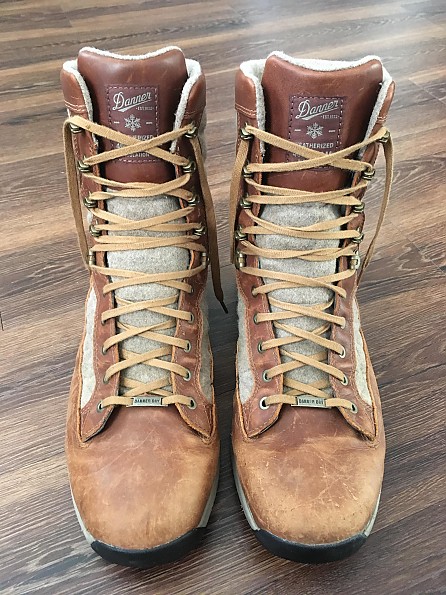
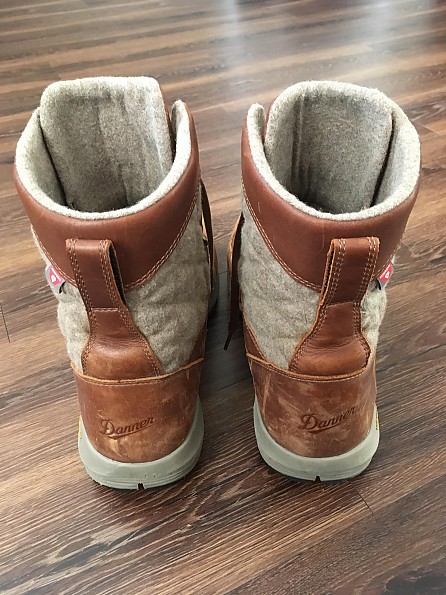
Being completely honest, when I saw the boots, I thought they'd be twice as heavy equally they actually are. Being 8-inch winter boots with insulation, leather, and a grippy outsole, I thought they would be northward of 2 pounds. each (32oz), like most other winter boots I've owned. Instead, I weighed them out-of-the-box at 24.9 oz. (correct kick) and 24.6 oz. (left kick), for a combined weight of 49.5 oz (just above the manufacturer claim of 48 oz., simply then again, I clothing a size US13/EUR48/UK12.5, which is bigger than your average boot, and so I'd say the claim is accurate).
I failed to counterbalance them subsequently hiking in the rain/snow, to run into how much water weight the wool outer absorbs, simply speaking from experience, I didn't notice any significant weight gain when the boots were wet. If I have the chance to go along testing in wet, wintry weather, I will update this department accordingly.
Fit and Comfort:
My feet took a liking to the Danner Raptor 650s as soon as I took them out of the box. Generally speaking, I have long and slightly narrow feet, with normal arches, which luckily equates to having pretty forgiving feet. Virtually boots are at least okay for me, but the Raptor 650s are more than just okay, they are downright comfortable. No burglary fourth dimension was needed at all and the comfort hasn't faded with time.
With near new footwear, I typically like to start irksome, maybe with a short, flat hike or even a walk around the cake a few times, just to get a sense of fit, comfort, potential tight spots, gaps, etc. I didn't have that pleasure with these boots, equally the woods were calling to go hunting almost immediately later on they arrived.
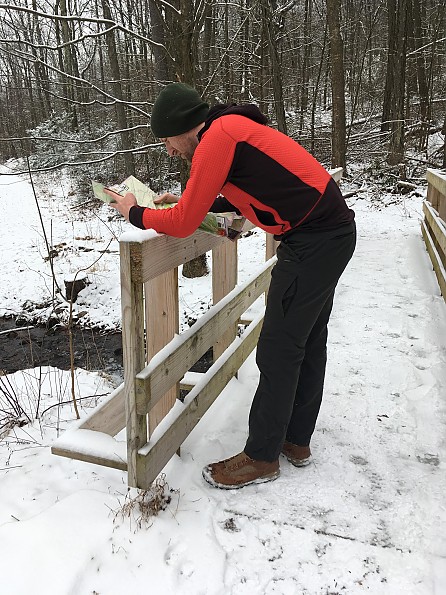
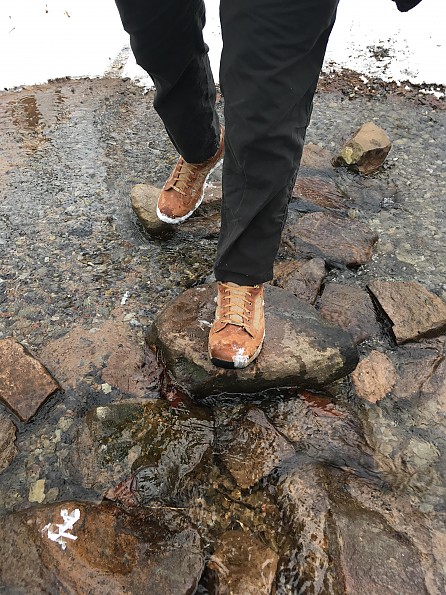
So the offset time I wore them out of the house, I trudged through thickets, hopped over downed trees, strided across wet fields, and gingerly stepped over/through semi-frozen winter streams from dominicus-up to sun-down. It was a long day of hunting (estimated time on my anxiety was five-half dozen hours) that put the boots to the test. 2 things stood out that showtime day of testing, the Raptor 650s are comfortable, and I didn't need to wear quite as warm of socks as I was used to with other winter boots.
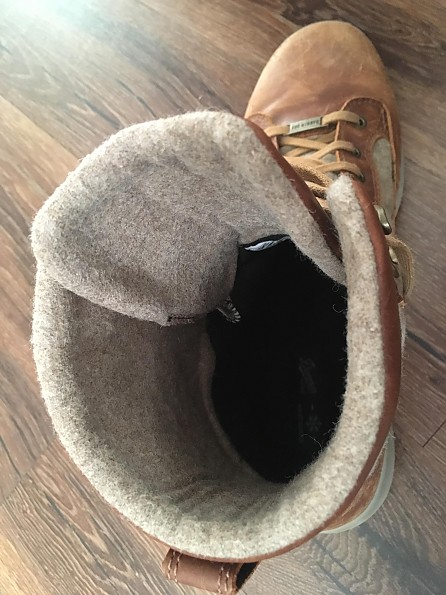
Since then, I've worn them with a variety of socks, usually going with a slightly lighterweight sock than I was accepted to for wintertime hiking. In the past, I may have used a heavier sock, but these are most comfortable with midweight hiking socks. Considering the top of the inner is lined with comfortable merino wool, slightly shorter socks aren't a big problem. When wearing a slightly shorter sock, I didn't notice any negative upshot of rubbing.
Insoles:
The footbed is easily removable, if needing to make footbed adjustments or to add aftermarket insoles. I personally found the insoles to be fine, but not quite equally amazing every bit the manufacturer's claims (i.eastward. "maximum cushioning and support" and "open-cell polyurethane for amend heat dissipation and air apportionment"). Admittedly, my feet aren't equally sensitive to these problems as they are for some, but I personally think the insoles are boilerplate and anyone needing custom insoles will probably remove these and add their custom ones anyways.
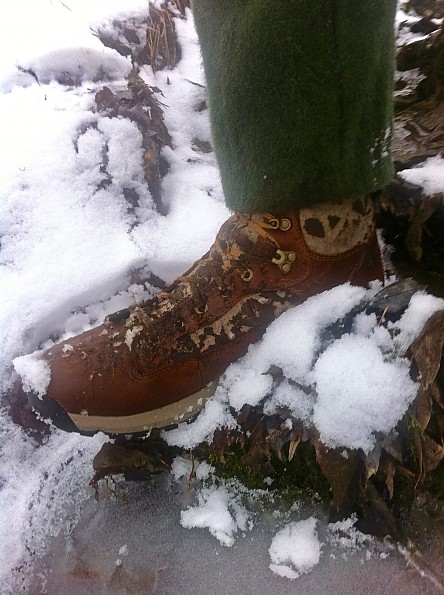
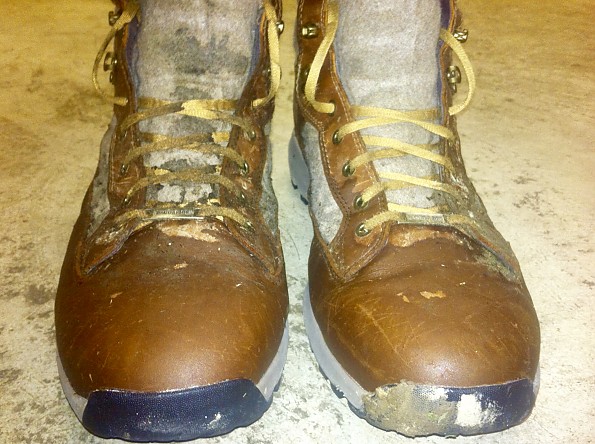
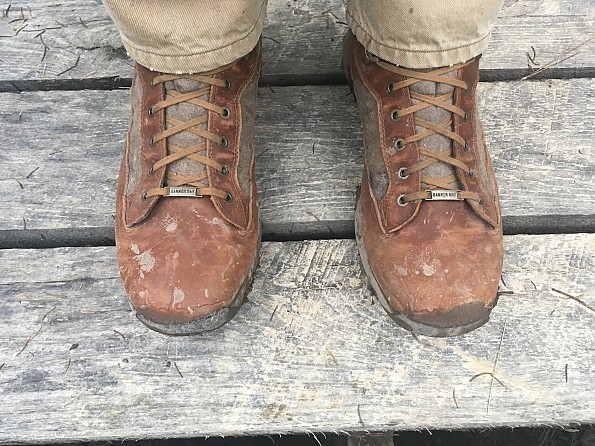
The above two photos are from the first day of use (v-6 hours of walking through brush, woods, soggy fields, and much more than).
Discomfort:
The only discomfort I experienced during the three months of testing was during the final portion of a hike that required road walking. Nearly of this trail was forested, but in guild to consummate the loop back to the automobile, it required a mile-long road walk at the very cease. Past the time I got back to the car, my feet were and so ready to go out of the boots. No blisters or chaffing, but simply sore feet. These boots are made for trails and earth underfoot, non hardened surfaces like pavement and cement. Also that one issue, I've experienced no other discomfort.
Temp Control:
The Danner Raptor 650's are designed for winter conditions—maybe not hiking across Antarctica, but reasonable winter conditions. With their 400g of PrimaLoft Aureate insulation, I've worn them in temps as low equally -20°F (-29°C) with a pair of thick wool socks and did not feel the cold penetrate my feet (I did yet feel it penetrate other parts of my body).
I wasn't out in these conditions very long (15-20 minutes) and was moving pretty consistently, so I tin't exactly say what their lowest temp rating might exist. For me personally, I institute the ideal temp range to exist somewhere in the single digits through the lower 30'due south F (approx. -17°C through 2°C). To a higher place that, the boots are a picayune too warm.
I've too found that doubling-upwardly socks or wearing my thickest/warmest pair of wool socks isn't really necessary unless I'thousand not moving much in the boots. In near cases, a midweight hiker sock has been sufficient and comfortable.
The only fourth dimension I experienced excessive heat retention (i.e. super sweaty feet) was when hiking in my thickest of wool winter socks. I suspect the wool panels have a manus in offering good temp control, and even when they get caked in snow or soaked, the internal temperature doesn't seem to be negatively affected.
Water Resistance and Dry out Fourth dimension:
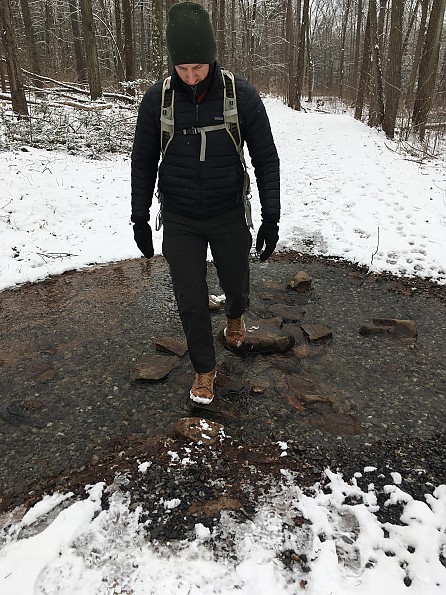
I was reminded of the aphorism "don't estimate a book past its comprehend" while testing the waterproof abilities of the Danner Raptor 650 boots. From the looks of them, I didn't wait much in terms of keeping my anxiety dry out. However, I speedily and repeatedly realized that the waterproofness provided by the Danner Dry lining is actually pretty solid. During the snowy winter with on-once again-off-once again snow melts, I've hiked through some pretty moisture and sloshy conditions, and the Raptor 650s take kept my feet perfectly dry.
Notwithstanding, having an upper made of a combination of total-grain leather and merino wool, this role of the boot certainly takes a while to fully dry after existence exposed to wet conditions. I don't use a kicking dryer, only ambience air inside the house, so the kick outers tin have the better part of a day to fully dry out if they are totally soaked.
Uppers:
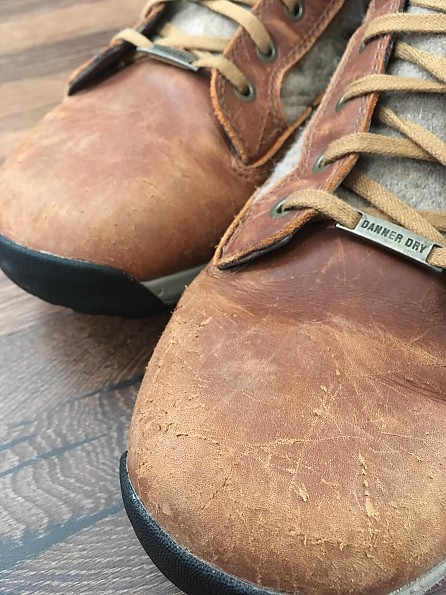
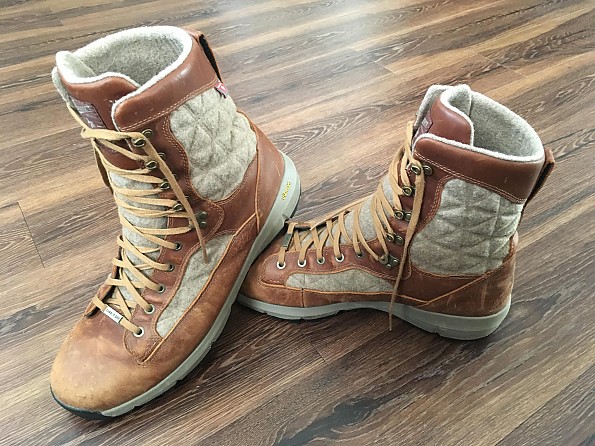
The same leather and wool upper was new for me. At commencement sight, I thought it was one part boot, one part slipper. Throughout testing, I couldn't pinpoint whatsoever particular advantages to this combination besides perhaps wet and smell control with the merino wool and the durability that leather can provide. The one drawback that I noticed repeatedly in the snow was that snow would block or clump on the exposed wool parts of the upper. Not a large problem, just unavoidable equally far as I could tell.
Being a new-to-me combination of materials, I wish the manufacturer would have included or posted on its website proper care instructions specifically for these boots. (Notation: Danner does have a general boot care page on its website, simply zero specific to these boots.) In my feel, leather and wool are not treated or cared for the same mode, so I am curious the best way to care for these boots to ensure they concluding a long time.
Near any 8-inch wintertime boot will provide a certain degree of protection, merely due to their lightweight materials and lack of any significant toe cap, these boots offer just a basic level of protection. The Raptor 650s shield the wind, the h2o, and the cold just fine, and aside from some bumps to the feet while bush-whacking through deep thickets, this minimal protection never bothered me. It'due south a tradeoff that I am personally okay with.
Traction:
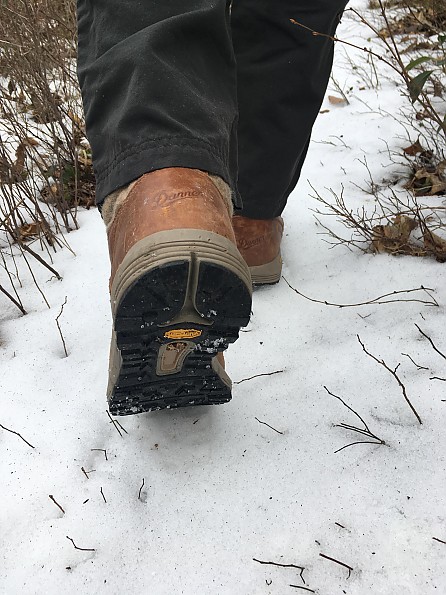
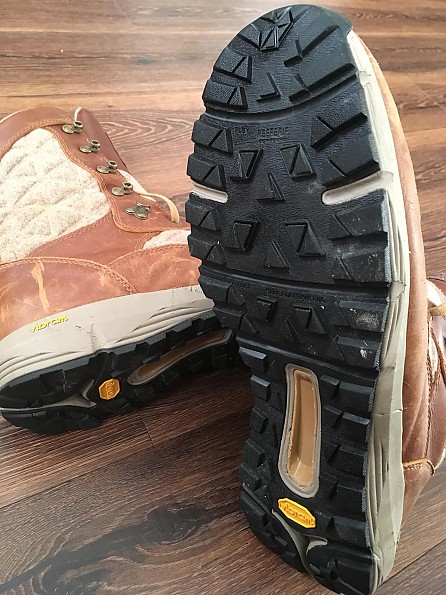
The Vibram Escape outsole, which is part of Vibram'southward Megagrip technology, does a fine chore at keeping me on my anxiety and off my butt. Good traction is one of those elements that is much more noticeable when you don't have it, rather than when you lot do have it. With the varying terrains, elements (ice, rain, slush, etc.) and inclines/declines I've hiked this winter, I never really noticed how practiced the traction of the boots was until I reflected and realized that I never struggled with slipping, sliding, or doubtfulness underfoot. I'd say going unnoticed is the mark of pretty good traction.
I personally do not apply traction devices (eastward.chiliad. Microspikes), so I accept no experience as to how the Raptor 650 boots would pair with such things. My biggest business organisation would be where the device makes contact with the upper, assuming it would work better if the contact indicate is on the leather and not the wool, but that is only speculation.
Recommendation:
I'd recommend the Danner Raptor 650 boots to those who desire a multi-purpose pair of boots for winter hiking or hunting (or actually for most full general winter purpose uses). Don't expect these to exist your next work boot or fast-and-light hikers, but rather expect a versatile wintertime boot that handles the common cold and wet elements with ease. I really like them for full general cold-atmospheric condition hunting purposes (in the stand up, on the ground, or afoot) and for winter dayhikes.
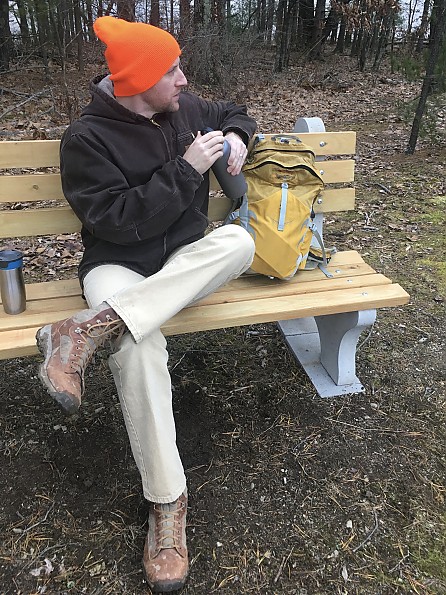
Note: The Danner Raptor 650 boots are bachelor in men'due south and women's, which announced to exist pretty similar, with some minor changes (i.e. faux fur on the women's). This review is specifically for the men's version.
Experience
I've been hiking and hunting for more than twenty years, and during many of the latest years, I've spent more time in the woods during the winter than any other season. Needless to say, many pairs of boots have come and gone over those years.
Source: https://www.trailspace.com/gear/danner/raptor-650/
0 Response to "Danner Womens Raptor 650 400g Insulated 8in Boot Review"
Post a Comment